
Search Kenosha Police Records
Kenosha Police Records are easiest to follow when you start with the police department's open records process and then move to municipal court or Joint Services only if the record has already shifted into another city function. Kenosha uses a Public Information Officer, a Records Unit, and a separate forms page, so the main job is deciding whether you need a report, a city citation, or a copy of a document that another city office stores. That split matters. It keeps the request focused and helps you avoid sending a police question to the wrong city desk.
Kenosha Police Records Requests
The Open Records page at Kenosha Police Records Open Records confirms that the department handles public requests through an official city process, even though the page currently shows no downloadable public documents in its repository. That does not mean the records do not exist. It means the request still needs to go through the department's official channels. The open records policy PDF at Kenosha Police Records policy explains how the department reviews requests, what it may withhold, and how the legal custodian and Public Information Officer handle release.
The department's contact page at Kenosha Police contact information gives the direct records-related number as 262-605-5015, the general non-emergency number as 262-605-5200, and the department address at 1000 55th Street, Kenosha, WI 53140. That makes the records path much clearer. If your Kenosha Police Records request is about a report, a booking, or another police file, the Records Unit is the correct first call. If your question is about how the department handles the request, the PIO and the records policy are the next stop.
When you prepare a request, keep it specific.
- Name of the person or business involved
- Date or date range of the incident
- Location of the event
- Report number, if you have it
- Type of record you need
That kind of detail helps Kenosha Police Records staff find the right file quickly. It is especially important when the same incident has a police report, a municipal citation, and a separate evidence record.
Kenosha Public Information
The Public Information page at Kenosha Police Public Information introduces Lieutenant Adam Jurgens as the Public Information Officer. The page explains that he approves information released to the public and media, which means he is part of the city's transparency process. That is useful for Kenosha Police Records because it shows there is a single public-facing review point when the department decides how much can be released and how it should be framed.
The open records policy makes the access limits clearer. It says the department reviews each request, balances disclosure against privacy and investigation concerns, and protects certain categories of information. Juvenile records receive special treatment, and active investigations can limit what is released until the case is no longer open. That is not unusual. It is simply how Kenosha Police Records are handled when the public interest in disclosure has to be weighed against a real law-enforcement need.
The policy also helps explain why some requesters are sent back for more detail. A request has to reasonably describe the record. If it is too broad, the department may not be able to determine what file is being sought. That is why a carefully written Kenosha Police Records request usually moves faster than a general ask for "all reports." The PIO, the Records Unit, and the policy PDF all point in the same direction: be specific, and use the department's own channels.
Kenosha Police Records and Joint Services
The Joint Services page at Kenosha Joint Services explains that the agency is a separate government entity that stores and supports records for the police department and the county sheriff's department. It also makes a key point: Joint Services is not the legal custodian for every request. That distinction matters a lot for Kenosha Police Records. It tells you where records may be stored or processed, but it also tells you who must answer the request in a legal sense.
Joint Services is headquartered at 1000 55th Street, the same address as the police department. The page describes the Records and Public Counter as part of the agency's support structure, which is why it often appears in searches for police files. But the department's open records policy still controls the legal response. In practice, that means Joint Services can help store, route, or support Kenosha Police Records, while the police department's custodian and PIO remain responsible for release decisions.
The forms page at Kenosha Police forms is another practical tool. It includes the Citizen Self Report Form and the Retail Theft Delayed Report Packet, and it sends people to the Records Unit address at 1000 55th Street for paper submissions. That makes the forms page a direct bridge between a public report and the records side of the department. If your Kenosha Police Records search starts with a citizen report or a delayed theft report, the forms page is the correct route.
Kenosha Municipal Court
Some Kenosha Police Records end up as city citations rather than open police reports. The municipal court page at Kenosha Municipal Court explains that the court handles traffic and municipal ordinance cases within the city. That is important because a police contact can turn into a citation, and once it does, the record starts following the court process instead of the records process.
The payments page at Kenosha Municipal Court payments gives the public the city's payment options and shows how to handle fines and fees tied to citations. That helps separate police reports from court obligations. If you have a citation number, the payment page can be part of the next step after you locate the case. If you have a report number, the records unit is still the better starting point for Kenosha Police Records.
Parking tickets follow another path. The parking citation page at Kenosha parking tickets uses a separate processing center and payment route. That is useful to know because a parking citation is not the same as a police report. It may come from city enforcement, but it does not use the same request path as a general Kenosha Police Records file.
Kenosha Police Records Images
The police department page at Kenosha Police Department is the best visual anchor for Kenosha Police Records because it shows the department's public-facing home page.
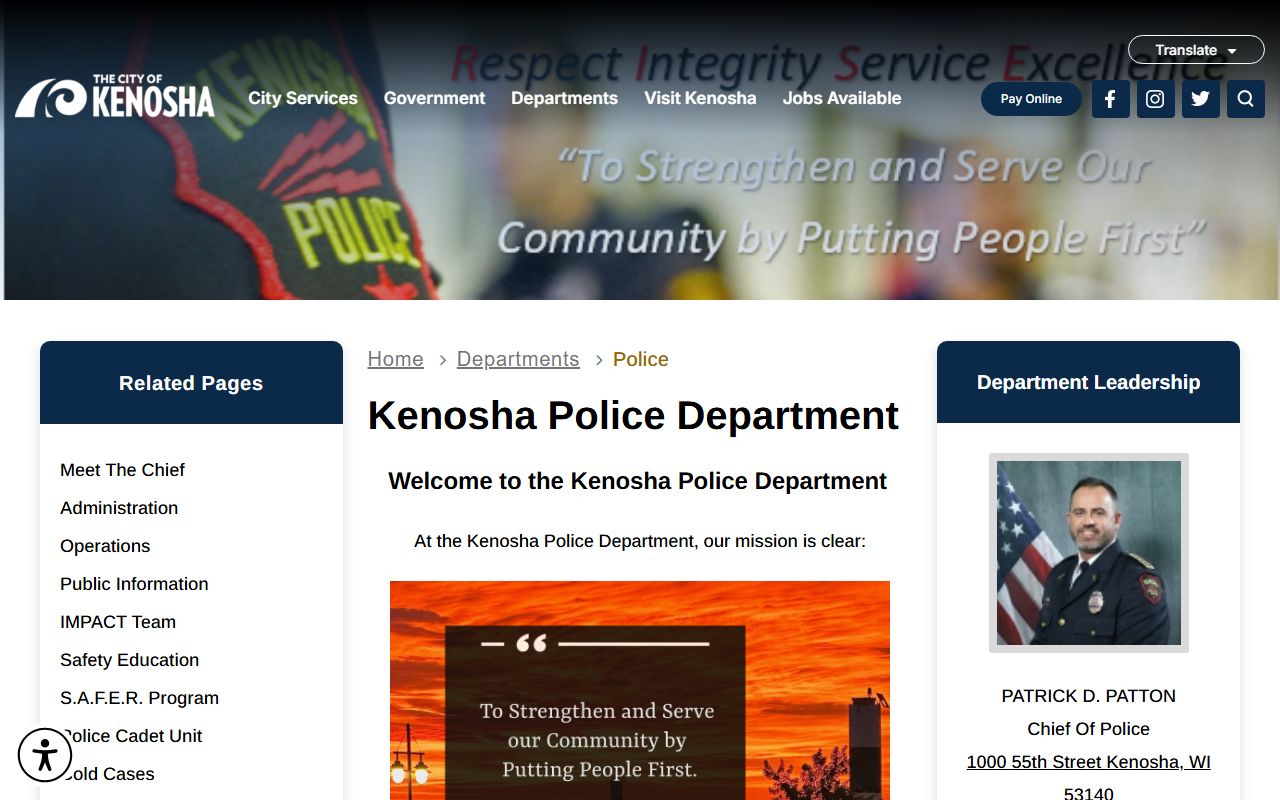
That image helps the reader orient the request before moving into open records, forms, or court pages.
The city NextRequest portal at Kenosha records request portal is only a routing clue and should not be treated as the records policy itself.
It still shows that the city has a vendor intake path, but the department's records policy and custodian remain the real authority.
The department NextRequest portal at Kenosha Police Department request portal is also only a routing clue.
Use it as a sign that records requests are routed electronically, not as a substitute for the city's open records process.
Kenosha Police Records Help
If you are unsure where to begin, identify the record type first. A police report belongs with the Records Unit. A question about release rules belongs with the PIO or the open records policy. A city citation belongs with municipal court. A citizen self report or delayed theft packet belongs with the forms page. That simple split keeps Kenosha Police Records from being sent to the wrong office.
It also helps to ask for only what you need. Use the date, place, report number, and names that are tied to the incident. If the request touches juvenile material or an active investigation, the department may limit or delay release. That does not mean the search failed. It means the department is applying the rules that govern Kenosha Police Records and deciding what can legally be released.
The city's own pages give a reliable path: open records for the request, public information for the approval point, joint services for support and storage, forms for citizen reports, and municipal court for citations. That sequence is the clearest way to handle Kenosha Police Records without wasting time on the wrong office.